Discovering Depth in a Subsea ROV Company
B2B Copywriting & Messaging
OVERVIEW
In an industry dominated by billion-dollar corporations, Deeptech breached the surface with fresh sea legs. As a new player in ocean engineering, they faced the classic underdog challenge: how do you earn credibility against established giants?
Initially, Deeptech didn't exist — no competitor research, visual direction, or messaging system. This posed a problem: how do you build an entire brand? Research found a guiding principle that framed the solution: B2Bs leveraging personalization can increase conversion rates by up to 80%.
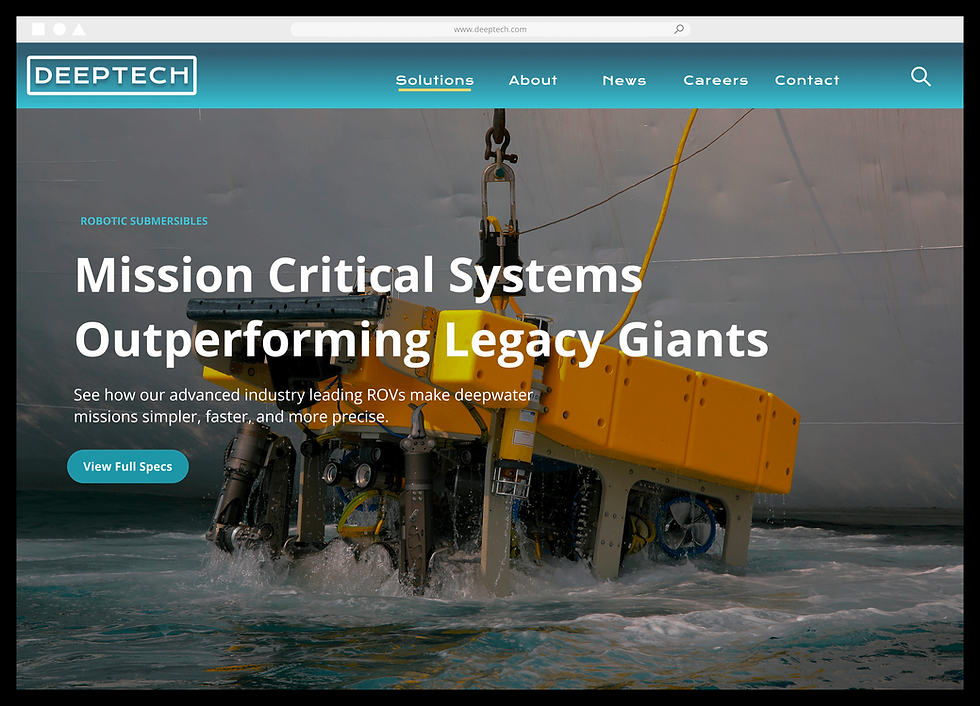
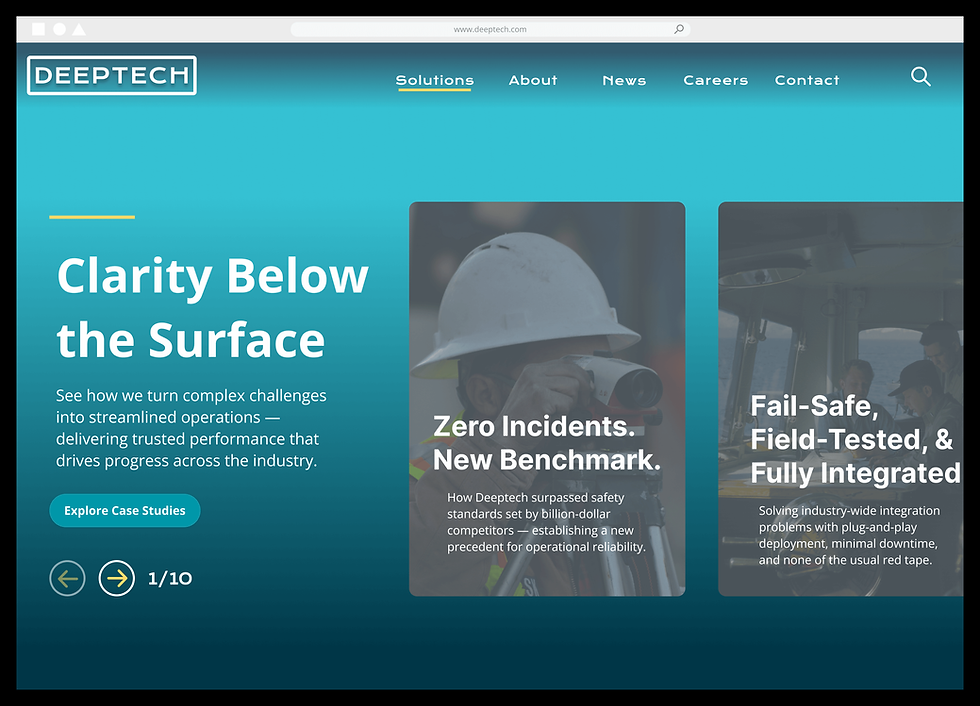
The goal of this project was to craft Deeptech’s identity from the ground up — combining the human-centered personal touch of a boutique operation with the trusted high-performance of a large-scale company. This case study presents a unified brand system, complete with a marketing toolkit and web design — built to convert and communicate with the same precision as their ROVs scouring the ocean floor.
ROLE
Copywriter & Brand Strategist
— end-to-end brand &
messaging development
Brand Messaging & Strategy
— brand voice
— mission statement
— internal & external values
— tagline & slogans
— value propositions
— messaging pillars
— key marketing statements
Visual Identity
& Design Integration
— logo system
— color palette
— moodboard
— personas
— styleguide
Research & Analysis
— competitor benchmarking
— insight synthesis
— narrative analysis
— tone-of-voice analysis
— SEO strategy
Web Copy & Experience
— narrative flow
— information heirarchy
— scroll-through prototype
TIMEFRAME
June – Aug 2025
TOOLS
Figma, Figma Slides, Excel
& Google Keyword Planner


CHALLENGES
No Brand Identity
— Built a unified brand narrative from the ground up
No Market Positioning
— Established B2B positioning through competitor analysis
Jargon Heavy Language
— Simplified technical copy while preserving authority
Expert B2B Audience
— Balanced human-centric messaging with technical rigor
OBJECTIVES
Present Competitor Analysis
— Researched top B2B company using SWOT & copy audits
Construct Brand Messaging System
— Defined voice, values, mission, tagline, & value propositions
Test Copy Deliverables SEO
— Evaluated copy performance for clarity & engagement
Deliver Brand System & Web Design
— Translated messaging system into a scrollable web prototype
COPYWRITING & BRAND STRATEGY
Messaging Framework


Research
Strategize
Copy
Deliver

Methodology Spotlight
This project used a novel concept I named, Empathetic Reverse Engineering — which infers what customers value most from what top competitors do right in their messaging.
RESEARCH
BACKGROUND
The competitor analysis began with a heuristic evaluation of Oceaneering International, a global leader in advanced robotics. Operating from the deep sea to outer space, Oceaneering blends technical precision with bold innovation — making their brand messaging system ideal for benchmarking. Seven key forms of web copy were audited:
— Headline
— Tagline
— Slogans
— Positioning Statements
— Core Values
— Calls to Action (CTAs)
— Brand Narrative Pillars
This competitor analysis uncovered what drives effective B2B messaging. Through SWOT analysis, copy audits, and benchmarking alternative messaging assets designed in Figma, this study generated insights later applied to Deeptech. To measure results, one quantitative and five qualitative key performance indicators (KPIs) evaluated copy performance:
Quantitative:
— Estimated Monthly Searches (SEO)
Qualitative:
— Tone Quality & Consistency
— Focus & Clarity
— Voice & Agency
— Brand Identity Alignment
— Emotional Accessibility
SEQUENCE
Synthesizing Quantitative & Qualitative Data
Competitor Analysis
Persona Creation
Open Card Sorting
Data from the competitor analysis were synthesized into actionable insights, informing Deeptech’s messaging system. These insights were reverse-engineered into personas, aligning customer motivations with brand perception. Patterns from these personas were organized through open card sorting, revealing themes that guided copy decisions.
By learning from Oceaneering’s narrative strategies and addressing their weaker points, Deeptech evolved into a confident, credible, and accessible brand — built through targeted research.
QUESTIONS
Oceaneering Competitor Analysis
Question 1: Tagline Strategy
What is the impact of burying the tagline, rather than using it as the homepage headline?
Question 2: Reliable Voice
How does the messaging convey expertise and partnership to their B2B audience?
Question 3: Narrative Cohesion
How does Oceaneering’s core values, voice, and overall brand identity align across the site?
Question 4: Optimization Ability
What opportunities exist to refine their copy for clarity, performance, and brand alignment?
SWOT ANALYSIS
Oceaneering's Messaging
Strengths
— Bold, confident voice across messaging
— Flexible slogans support diverse sectors
— Emphasis on trust, outcomes, expertise
— Brand narrative subtly positions the company as a partner, not just a provider
Weaknesses
— Not consistently speaking to customers
— Partnership is not fully crystalized
— UI misses opportunities for creativity
— Brand voice is sometimes lost in lieu of corporate professionalism
Opportunities
— Add personalization to legacy slogans
— Speak to customers across messaging
— Highlight partnership in brand values
— Align human-centered CTAs more tightly with customer needs and user intent
Threats
— Competitors may outpace in SEO
— Broad language diminishes uniqueness
— Tone often misses emotional resonance
— Inconsistent tone could dilute perceived trust and customer urgency
INSIGHTS & THEMES
Oceaneering Copy Audit (Qualitative)
The following emerged from a copy audit conducted as part of the broader competitor analysis. This framework distilled Oceaneering’s brand narrative into five data-driven insights:
— Bury the Tagline? Smart Move: SEO-rich headlines that solve customer problems outperform clever phrasing, driving visibility and conversion.
— Broad Messaging Can Foster Trust: Clear, accessible language proves more credible than jargon in high-stakes B2B sectors.
— Positioning Must Speak to Customers: Even strong brands lose impact when their copy talks about themselves instead of directly engaging the audience.
— Partnership is the Core of Credibility: Humanizing a complex, technical brand through collaboration strengthens reliability and trust.
— Creative CTAs are Highly Beneficial: Small shifts like changing “Submit” to “Launch Discussion” turn interaction into collaboration, reinforcing partnership.
Without internal data or direct client access, the core assumption was that Oceaneering’s strongest messaging reflects what their customers value most. Synthesizing the five insights through persona development and open card sorting revealed clear themes:
— Trustworthy Support: Clients need assurance that results come from human expertise, not automation; messaging should project accessibility and reliability.
— Data-Driven Validation: B2B buyers and stakeholders require measurable proof; every claim must be supported by metrics or demonstrable outcomes.
— Real-World Proof: Testimonials, case studies, and field examples demonstrate capability under pressure and reinforce credibility.
— Human-First Partnership: Brands that emphasize collaboration and shared success foster long-term loyalty beyond individual transactions.
— Simplicity & Usability: Clarity in message reflects clarity in experience; unnecessary complexity erodes confidence.
— Safety & Risk Minimization: Communicating reliability and mitigation of risk strengthens trust in industries where stakes are high.
OUTCOMES
Oceaneering SEO (Quantitative)
— The following highlights a key research insight and its measurable impact:
The competitor analysis began with the hypothesis that brand identity is best signaled through a homepage tagline. Oceaneering challenged this notion, using an SEO-rich headline that outperformed its tagline. Deeptech showed the opposite pattern — its homepage tagline outperformed its original headline, and by further optimizing high-performing copy, its headline surpassed Oceaneering’s benchmark by ~8%.
These outcomes reveal that while SEO drives measurable impact, implementation is not one-size-fits-all. Ultimately, conversion depends less on brand description and more on alignment with user search intent.
.png)
SEO OUTCOMES
| TAGLINE v.s. HEADLINE
| ORIGINAL v.s. REFINED
SEO drives reach — Deeptech’s execution, informed by competitor analysis, delivers measurable results:
Oceaneering
+1,009%
Headline Outperforms Tagline
110K – 1.1M → 1.22M – 12.2M
Tagline
Headline
Deeptech
+50.7%
Tagline Outperforms Headline
213K – 2.13M → 321K – 3.21M
Headline
Tagline
Deeptech
+520%
Keyword Reach from Headline Optimization
213K – 2.13M → 1.32M – 13.2M
Original
Refined
PROJECT IMPACT
Brand Foundation
Addressed Deeptech’s underdog challenge by building a messaging system and marketing toolkit from scratch — positioning them as a credible, partner-first brand across the web prototype.
Messaging Research
Identified core strategies for effective B2B copy by reverse-engineering an industry leader through SWOT analysis, SEO evaluation, copy audits, and benchmarking alternative messaging.
Measured Impact
Optimized Deeptech’s homepage SEO by translating research insights — integrating high-performing keywords to increase headline reach by 520%, surpassing Oceaneering’s benchmark by 8%.
DELIVERABLES
BRAND MESSAGING SYSTEM

— DEEPTECH —
Primary
Positioning Statements
Messaging Pillars
Value Propositions
Brand Voice
Tagline
Mission Statement
Supporting
Brand Persona
Internal Values
External Values
B2B Stat Guiding Principle
Slogans
Summary
Unified Deeptech's language, logo suite, and visual direction — positioning them as a future-focused partner with the energy of a lean startup.

TAGLINE

MISSION STATEMENT

MESSAGING PILLAR 01

MESSAGING PILLAR 02

MESSAGING PILLAR 03

POSITIONING STATEMENT

VALUE PROPOSITIONS

BRAND VOICE
— LOGO SUITE —
Primary
Main Logos
Supporting Logos
Icons
Typography
Supporting
Suite Summary
Summary
Translated Deeptech’s identity into modular wordmarks, American-inspired iconography, and a typography system rooted in control-room interfaces and ROV design.

MAIN LOGOS

SUPPORTING LOGOS

ICONS

TYPOGRAPHY
— AESTHETICS —
Primary
Color Palette
Color Blends
Logo Application
Supporting
Aesthetics Brainstorms
Summary
Conceptualized Deeptech’s color, texture, and field imagery — defining them as technically sharp yet human-first: approachable without losing authority.

LOGO APPLICATION

COLOR PALETTE

COLOR BLENDS


.png)